
Payments in ANZ: A Market Maturing – and What That Means for Talent
Payments in ANZ feels different in 2026 – and the recent RBA surcharge decision has only accelerated that shift. For years, the narrative was simple: growth, adoption, disruption. That’s still true — but it’s no longer enough. What we’re seeing now is a shift toward a more mature phase, where margin, regulation, distribution and execution…

Published on May 13, 2026
Brad Johnson
Payments in ANZ feels different in 2026 – and the recent RBA surcharge decision has only accelerated that shift.
For years, the narrative was simple: growth, adoption, disruption. That’s still true — but it’s no longer enough.
What we’re seeing now is a shift toward a more mature phase, where margin, regulation, distribution and execution matter just as much as innovation.
From a recruitment perspective, the question has changed:
The Market Shift: Less Product, More Economics
Consumer behaviour has already moved:
• Mobile wallets now make up 40%+ of in-person transactions
• NPP is processing $6B+ daily
Payments are becoming invisible — and that shifts value away from frontend experience toward:
• Infrastructure
• Cost efficiency
• Routing capability
• Distribution
At the same time, consolidation is accelerating.

 Hiring: Still Active, But Far More Selective
 Hiring: Still Active, But Far More Selective
Hiring hasn’t slowed — it’s sharpened.
We’re seeing a split: some businesses reducing or restructuring, while others are hiring deliberately.
Consistent demand remains for:
• Enterprise / mid-market sales
• Commercial product leaders
• Risk, fraud & compliance
• Multirail payments expertise (cards + A2A)
This shift is only accelerating post-surcharge removal, where businesses are placing even greater emphasis on roles that protect revenue, optimise pricing or improve efficiency.
 Churn: Structural, Not Optional
 Churn: Structural, Not Optional
Churn is still high — but increasingly driven by restructuring, M&A activity, and margin pressure.
Businesses are redefining what “good” looks like — and that’s creating movement.
Retention now comes down to:
• Strategy clarity
• Leadership quality
• Confidence in where the business is heading
The Surcharge Decision: A Catalyst for Change
With the RBA confirming the removal of card surcharges, the impact on the payments market will be immediate – particularly from a talent perspective.
This is effectively a margin compression event.
In practical terms:
• Margins tighten across the board
• Pricing comes under pressure
• Consolidation likely accelerates
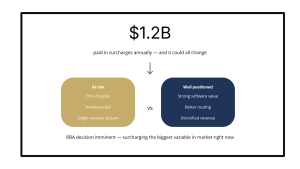
But from a recruitment lens, this doesn’t reduce hiring – it changes what good looks like.
We expect to see:
- increased demand for high-performing sales and account management talent
- greater focus on product, pricing and payments strategy capability
- continued investment in risk and compliance roles
At the same time, some businesses will restructure, while stronger players use this moment to scale.
The shift is clear: hiring in payments is moving from growth-driven to performance-driven.
Salary Expectations: Sales vs Account Management
One of the biggest shifts we’re seeing is around commercial roles — both new business and retention.
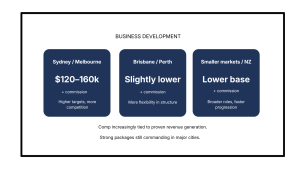
Business Development (New Logo Focus)
Still commanding strong packages, particularly in Sydney and Melbourne:
- Sydney / Melbourne $120k–160k base + commission (higher targets, more competition)
- Brisbane / Perth Slightly lower base, often more flexibility in structure
- Smaller markets / NZ Lower base, but broader roles and faster progression
Increasingly, comp is tied tightly to proven revenue generation.
Account Managers (Growth + Retention Focus)
This is where we’re seeing more variation — depending on book size, complexity and whether there’s an upsell component.
Market benchmarks (Australia):
• $90k–$110k base — typical mid-range
• $110k–$150k+ base — experienced / enterprise-facing roles
• OTE can push to $180k–$220k+ in more commercial / quota-driven roles
Across regions:
- Sydney / Melbourne → higher base, more defined segmentation
- Brisbane / Perth → broader roles, often hybrid AM/BDM
- Smaller markets / NZ → lower base, more ownership and progression
Key Shift: The BDM / AM Line Is Blurring
More roles now expect retention + growth, upsell/cross-sell responsibility, and ownership of revenue within an existing book.
Which is why we’re seeing:
• Account Manager salaries are moving closer to sales structures
• Variable comp is increasingly tied to account expansion, not just retention
What This Means Going Forward
Payments in ANZ isn’t slowing — it’s maturing.
Over the next few years, we’ll see:
- More consolidation
- Structural pressure on margins (accelerated by surcharge removal)
- More focus on commercial, pricing and optimisation capability
- More focus on efficiency and scale
And from a talent perspective:
- Hiring will stay active — but targeted
- The bar for top performers will keep rising
- The gap between strong and average talent will widen
Now, talent is the lever.
Final Thought
Published on May 13, 2026
Brad Johnson
Insights from our experts









From our blog
2026 State of the Workplace report reveals true market conditions
Job insecurity and polarised demand amount to a disorienting, sluggish job market. That’s what this year’s research found, published in the 2025/2026 annual Keegan Adams Financial Services Talent and Employment Report. Fear is driving an asymmetric job market, but forces are reshaping historic candidate movements, precipitating migration to smaller firms. Meanwhile, demand for very specific…

Latest news headlines on Australian labour market
From hiring challenges and talent shortages to salary trends across investment management and superannuation, Keegan Adams is at the forefront of conversations shaping the financial services, corporate services, and technology and transformation sectors. Drawing on insights from our latest 2026 State of the Workplace report, our team regularly contributes expert commentary and market intelligence to…

What does the future of work in Australia look like?
Last week, we were delighted to welcome clients, candidates and industry leaders to our annual Future of Work event, featuring renowned futurist and workforce expert Dr Ben Hamer. Attended by professionals from across HR, Talent Acquisition, People & Culture and business leadership eager to explore the trends shaping the future of work, the event offered…

Payments in ANZ: A Market Maturing – and What That Means for Talent
Payments in ANZ feels different in 2026 – and the recent RBA surcharge decision has only accelerated that shift. For years, the narrative was simple: growth, adoption, disruption. That’s still true — but it’s no longer enough. What we’re seeing now is a shift toward a more mature phase, where margin, regulation, distribution and execution…

The Shift in the Financial Controller Role Across Funds Management, Superannuation & FinTech
The Shift in the Financial Controller Role In recent months, we’ve observed a marked rise in demand for Financial Controllers across Funds Management, Superannuation, and FinTech sectors. Compensation data aligns with this trend, reaffirming that these roles now command higher salaries and expectations. Compensation Trends: What the Numbers Show Average base packages for Financial Controllers…

The Rise of Fractional C-Suite in Boutique Financial Services
Why private wealth and family offices are opting for flexible leadership Boutique financial services firms, particularly within Australia’s private wealth and family office sectors, are increasingly turning to fractional C‑suite executives. This model offers access to top-tier leadership without the long-term cost or commitment of a full-time appointment. For firms navigating growth, complexity, and regulatory…

Keegan Adams Recruitment Annual Event Recap – Boost Productivity & Retention in 2025
2025 Annual Report: The Evolving Workplace We are pleased to launch our 2025 Annual Report: The Evolving Workplace — our second annual report and a reflection of our ongoing commitment to providing a valuable resource to our clients and candidates each year. This year’s report goes beyond salary benchmarking, offering in-depth insights into how businesses…

The Evolution of Australia’s Superannuation Industry and Keegan Adams Recruitment’s Strategic Role
The Rapid Transformation of the Superannuation Sector The Australian superannuation industry is undergoing a period of rapid transformation, driven by consolidation, regulatory shifts, and the internalisation of investment management. As of the September 2024 quarter, total superannuation assets reached $4.1 trillion, reflecting a 3.7% increase over the quarter. This growth underscores the sector’s critical role…

Funds Management Distribution Market Update 2025
The Australian funds management distribution market is experiencing significant transformation as we move into 2025. In the face of evolving industry dynamics, fund managers are contending with a declining financial adviser base, institutional market consolidation, intensifying competition, fee compression, and shifting investor preferences. This update delves into the key trends, challenges, and opportunities shaping the…

Are you satisfied with your bonus?
In 2024, the Australian investment and wealth management industry is navigating a period marked by changing market conditions, regulatory shifts, and evolving workforce expectations. Bonuses and salary increases have become critical factors in attracting and retaining top talent, especially as firms strive to balance performance incentives with cost management amid uncertain economic landscapes. Trends…