
Keegan Adams Recruitment: Mid-Year Report 2026
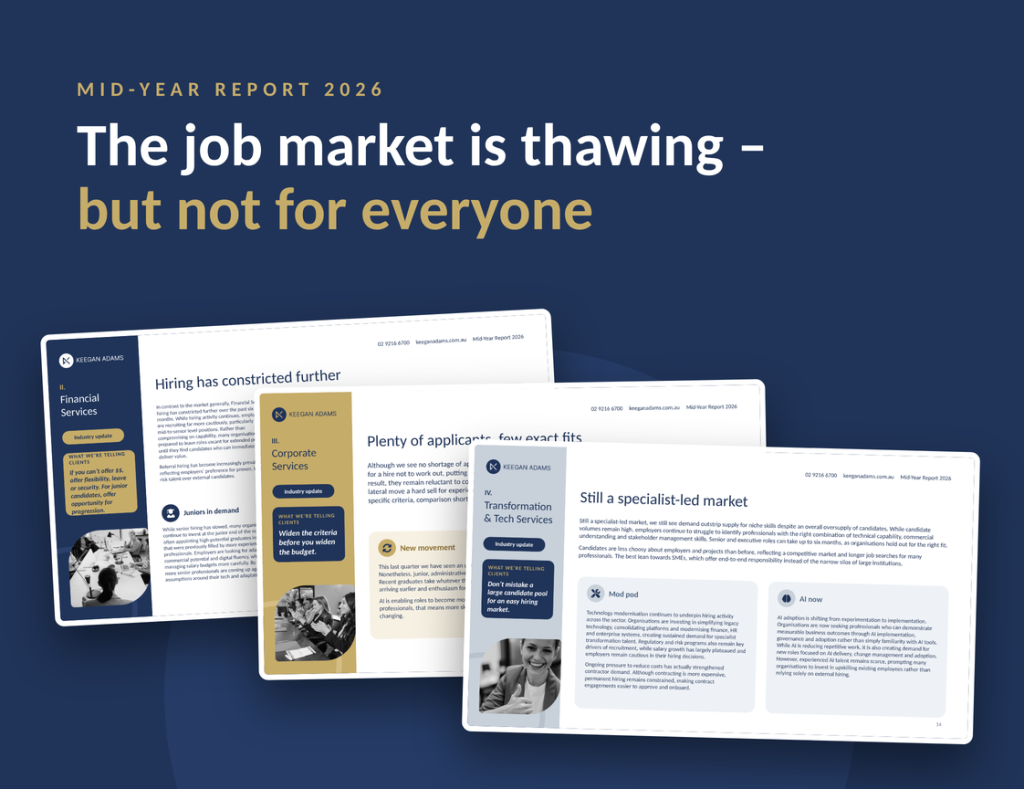
Finding the signal in the surge: Keegan Adams 2026 Mid Year Pulse report provides real data on market conditions Our 2026 midway State of the Workplace Update reveals record application numbers, low confidence, but cautious improvements. Mid-Year Report Our promised half-year update tracks the fastest-moving areas since the annual report. It found a thawing job…

Published on October 23, 2026
Saffron Stevens
Finding the signal in the surge: Keegan Adams 2026 Mid Year Pulse report provides real data on market conditions
Our 2026 midway State of the Workplace Update reveals record application numbers, low confidence, but cautious improvements.
Mid-Year Report
Our promised half-year update tracks the fastest-moving areas since the annual report. It found a thawing job market is thawing, although not uniformly across the board. Demand is returning and employers are cautiously going back to market, but candidates remain pessimistic.
Candidates – in financial services, corporate services and tech & transformation – now apply for more jobs and trust the market less. Employers hold out for exact matches, and flexibility outbids pay.
- 5.7 months: the average time candidates expect to take to find a suitable position, up 18% from their last job search
- Only a quarter are very confident or certain they can find a suitable role. Over a third are unsure they can find one at all. The market appears to be at the start of an upward bounce, but employers are still hiring selectively.
- Applications up 36%: candidates now send over 32 each month
- Juniors in demand, seniors going cold: tech-qualified juniors see more doors open, while senior professionals face assumptions about their tech, adaptability, and aspirations.
- Flexibility is the top reason to stay (52%) and to move (60%), ahead of salary
- Job seekers want culture. The happy want 15%: active seekers rank culture and new challenges above pay, while candidates content in their role would need a rise of 15% or more to move
- A large pool is not an easy market. Hundreds of applications overwhelm internal talent teams and make identifying quality a challenge
Claire Tate
Keegan Adams Managing Director Claire Tate said: “Candidates are working harder than ever and believing in the market less. They’re sending 36% more applications and still expect a six-month search.
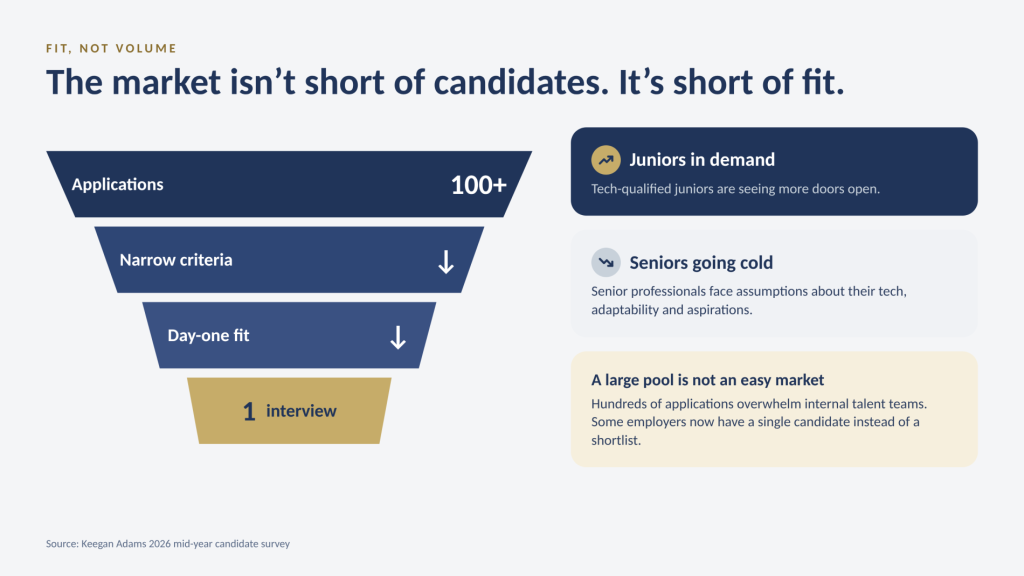
“The market isn’t short of candidates. It’s short of fit. A hundred applications can produce one interview.
“Meanwhile, hiring processes are screening out suitable candidates through both AI and human bias. Age is being treated as a risk, even as parameters are narrowed to like-for-like experience.”
Fit, not volume
A large candidate pool is not an easy hiring market. Employers are hiring on narrow criteria. Many want someone who can deliver on day one, and some now find they have a single candidate to consider instead of a shortlist. Recruitment takes longer, and vacancies stay open.
Juniors, especially with tech skills, are seeing more doors open. Senior professionals are up against assumptions about their tech and adaptability. One 57-year-old marketing manager told the survey: “Ageism isn’t theoretical – it’s happening to real people who still have decades of skill, loyalty, and capability to offer.”
Time over money
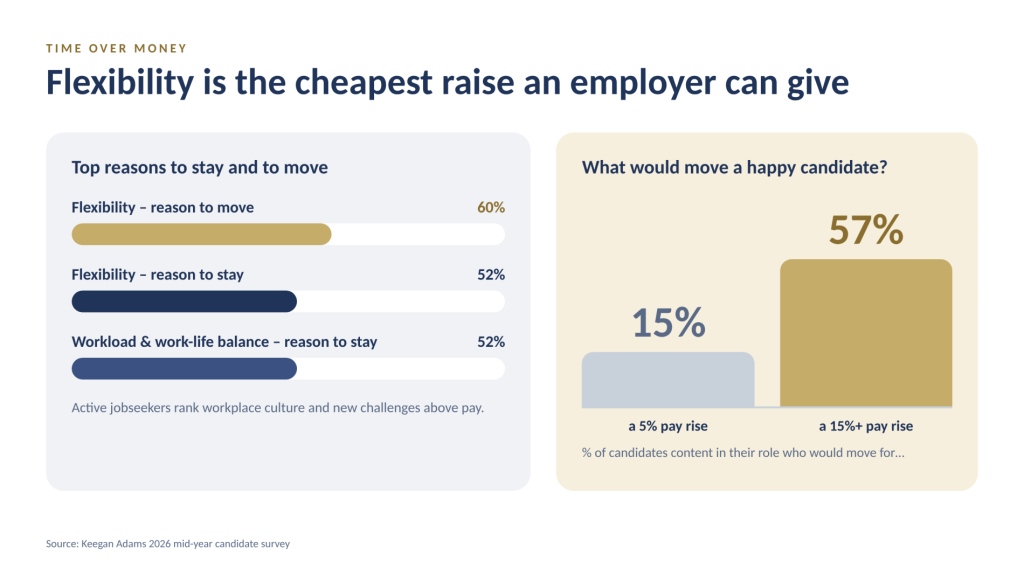
Salaries remain subdued, and motivations differ by situation. Job seekers rank workplace culture and new challenges above pay. Candidates happy where they are would need a rise of 15% or more to move. Only 15% would move for a 5% rise, against 57% for a rise of 15% or more.
Flexibility and workload count for more than money. Flexibility is the top reason to stay (52%) and to move (60%), with workload and work-life balance a close second for staying (52%).
Ambition is shifting too. Two in five candidates are less ambitious than before: 23% now put other parts of life ahead of career progression, and 18% are happy to stay at their current level. A quarter (25%) are more ambitious, and a third (33%) are unchanged.
Claire said: “With today’s budgets, employers can’t always tempt with salary. But this data shows what candidates really value: time, flexibility and workload.
“Flexibility is the cheapest raise an employer can give and will move more candidates than a 15% pay increase.”
AI
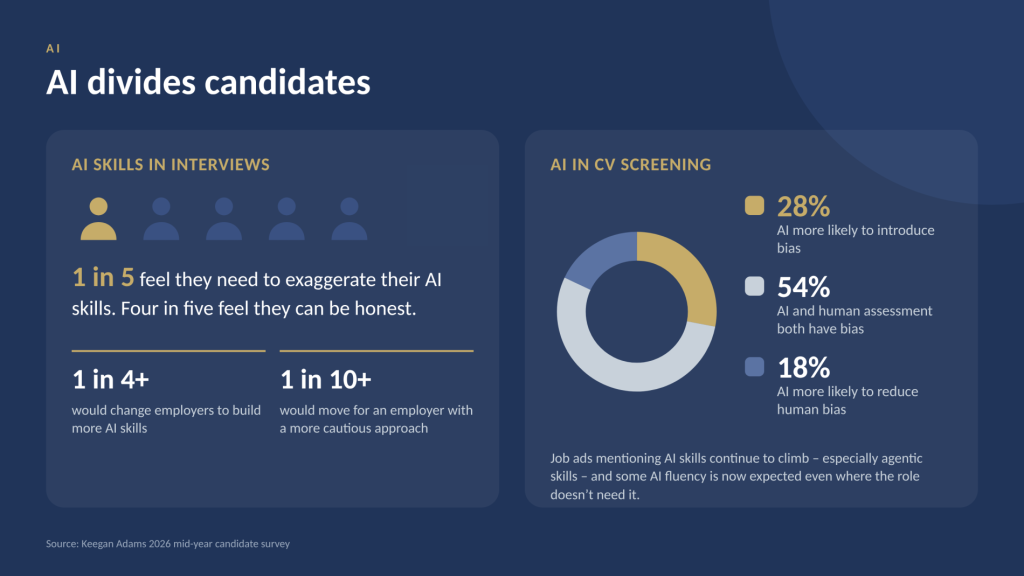
Job ads that mention AI skills continue to climb, particularly for agentic skills, and some AI fluency is now expected even where it isn’t needed for the role.
Workers are split. Over a quarter would change employers in order to build more AI skills, while more than 1 in 10 would move for an employer with a more cautious approach. Four in five feel they can be honest about their AI skills in interviews, leaving 1 in 5 feeling they need to exaggerate.
On CV screening, 28% believe AI adds bias, 18% think it reduces it, but the majority believe human and AI processes alike have biases.
Sector split
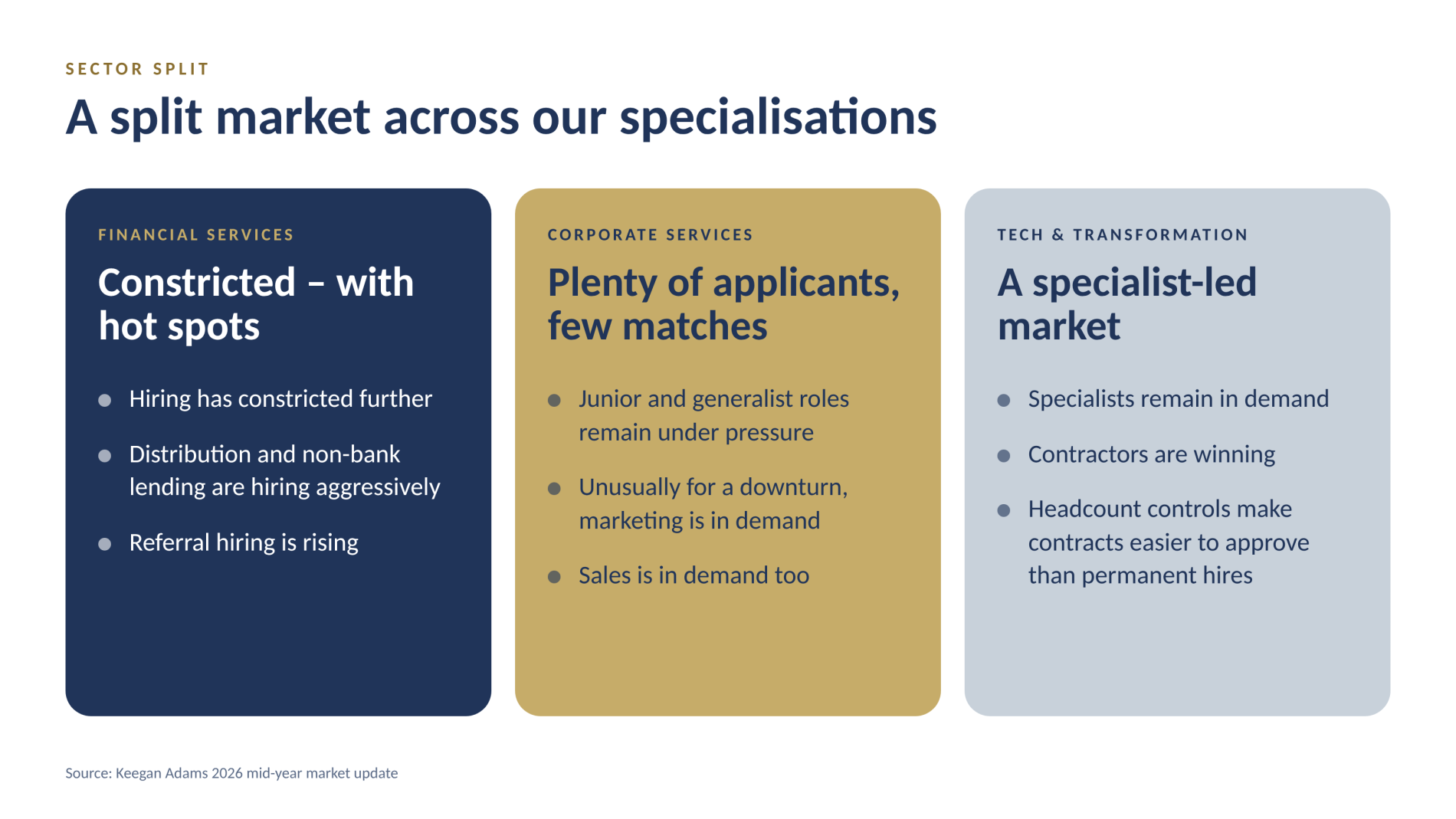
- Financial Services: hiring has constricted further, yet distribution and non-bank lending hire aggressively. Referral hiring is rising
- Corporate Services: plenty of applicants, few matches. Unlike fin services and tech, junior and generalist roles remain under pressure. Unusually for a downturn, marketing is in demand along with sales
- Tech & Transformation: a specialist-led market. Contractors are winning because headcount controls make contracts easier to approve than permanent hires
This is a split market. Hiring slowly feels safe, but it can be a business risk: the best candidates don’t wait around.
Employers who widen their criteria and move quickly will win the talent. Candidates who know their dealbreakers, and stay flexible on the rest, will find the opportunities.
If you’d like a copy of the full report, please complete the below form:
Published on October 23, 2026
Saffron Stevens
Insights from our experts






From our blog
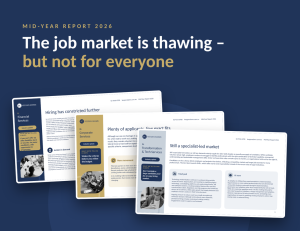
Keegan Adams Recruitment: Mid-Year Report 2026
Finding the signal in the surge: Keegan Adams 2026 Mid Year Pulse report provides real data on market conditions Our 2026 midway State of the Workplace Update reveals record application numbers, low confidence, but cautious improvements. Mid-Year Report Our promised half-year update tracks the fastest-moving areas since the annual report. It found a thawing job…

Reintroducing Technology & Transformation at Keegan Adams
Over the past 10 years, my career has been focused on project services, transformation and technology recruitment, working closely with organisations as they navigate change, build capability and bring new ideas and technology to life. Having now been with Keegan Adams for a year, I’ve had the opportunity to work closely with our clients, understand…
2026 State of the Workplace report reveals true market conditions
Job insecurity and polarised demand amount to a disorienting, sluggish job market. That’s what this year’s research found, published in the 2025/2026 annual Keegan Adams Financial Services Talent and Employment Report. Fear is driving an asymmetric job market, but forces are reshaping historic candidate movements, precipitating migration to smaller firms. Meanwhile, demand for very specific…

Latest news headlines on Australian labour market
From hiring challenges and talent shortages to salary trends across investment management and superannuation, Keegan Adams is at the forefront of conversations shaping the financial services, corporate services, and technology and transformation sectors. Drawing on insights from our latest 2026 State of the Workplace report, our team regularly contributes expert commentary and market intelligence to…

What does the future of work in Australia look like?
Last week, we were delighted to welcome clients, candidates and industry leaders to our annual Future of Work event, featuring renowned futurist and workforce expert Dr Ben Hamer. Attended by professionals from across HR, Talent Acquisition, People & Culture and business leadership eager to explore the trends shaping the future of work, the event offered…

Payments in ANZ: A Market Maturing – and What That Means for Talent
Payments in ANZ feels different in 2026 – and the recent RBA surcharge decision has only accelerated that shift. For years, the narrative was simple: growth, adoption, disruption. That’s still true — but it’s no longer enough. What we’re seeing now is a shift toward a more mature phase, where margin, regulation, distribution and execution…

The Shift in the Financial Controller Role Across Funds Management, Superannuation & FinTech
The Shift in the Financial Controller Role In recent months, we’ve observed a marked rise in demand for Financial Controllers across Funds Management, Superannuation, and FinTech sectors. Compensation data aligns with this trend, reaffirming that these roles now command higher salaries and expectations. Compensation Trends: What the Numbers Show Average base packages for Financial Controllers…

The Rise of Fractional C-Suite in Boutique Financial Services
Why private wealth and family offices are opting for flexible leadership Boutique financial services firms, particularly within Australia’s private wealth and family office sectors, are increasingly turning to fractional C‑suite executives. This model offers access to top-tier leadership without the long-term cost or commitment of a full-time appointment. For firms navigating growth, complexity, and regulatory…
Keegan Adams Recruitment Annual Event Recap – Boost Productivity & Retention in 2025
2025 Annual Report: The Evolving Workplace We are pleased to launch our 2025 Annual Report: The Evolving Workplace — our second annual report and a reflection of our ongoing commitment to providing a valuable resource to our clients and candidates each year. This year’s report goes beyond salary benchmarking, offering in-depth insights into how businesses…

The Evolution of Australia’s Superannuation Industry and Keegan Adams Recruitment’s Strategic Role
The Rapid Transformation of the Superannuation Sector The Australian superannuation industry is undergoing a period of rapid transformation, driven by consolidation, regulatory shifts, and the internalisation of investment management. As of the September 2024 quarter, total superannuation assets reached $4.1 trillion, reflecting a 3.7% increase over the quarter. This growth underscores the sector’s critical role…